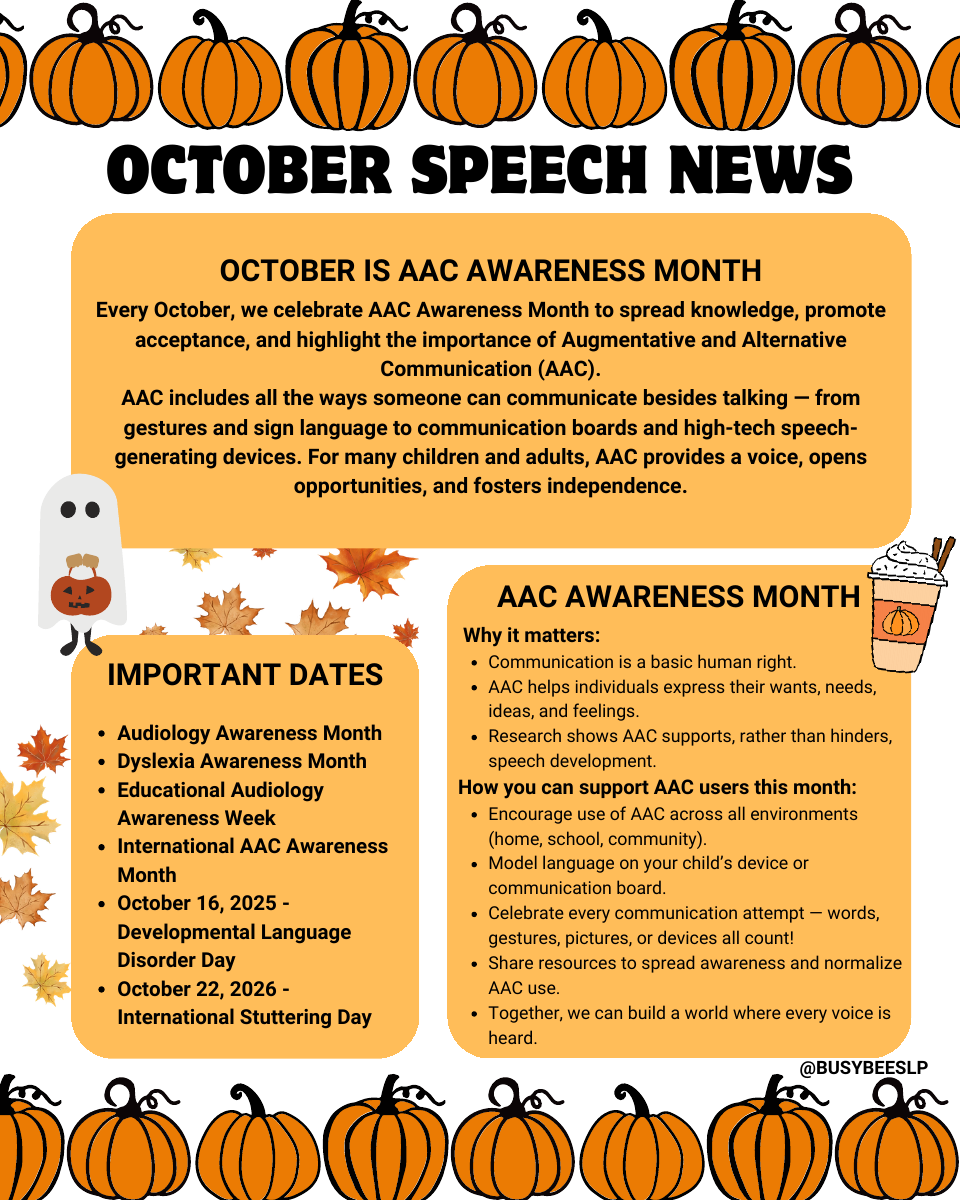
 Open the full newsletter
Busy Bee Bulletin
Open the full newsletter
Explore Resources
Find simple, affirming ways to support communication through the routines and play your family already enjoys.
Language
Dyslexia Awareness Month: What Parents Should Know
Learn about dyslexia, its connection to speech and language, early signs to watch for, and ways to support your child's confidence and literacy development.
Read MoreOctober is Dyslexia Awareness Month, an opportunity to learn more about dyslexia, recognize early signs, and help children feel confident and supported as they develop reading and language skills.
Dyslexia is a language-based learning difference that primarily affects reading and spelling. It is not related to intelligence, and children with dyslexia can have many different strengths and interests. With appropriate instruction and support, children with dyslexia can become successful readers and writers.
What Is Dyslexia?
Dyslexia is a specific learning disability that affects the development of accurate and/or fluent word reading and spelling. Children with dyslexia may have difficulty connecting letters with their corresponding sounds, recognizing words automatically, reading fluently, or spelling words accurately.
Dyslexia can look different from child to child. Some children may show noticeable reading difficulties early on, while others may compensate for their difficulties for years before struggling becomes more apparent.
Importantly, dyslexia is not caused by a lack of effort, motivation, or intelligence.
What Does Dyslexia Have to Do With Speech and Language?
Reading and spoken language are closely connected.
Before children learn to read, they are already developing important language skills that support literacy. These include:
- Understanding and using vocabulary
- Following directions and understanding sentences
- Learning and using grammar
- Recognizing and manipulating sounds in words
- Remembering and retrieving words
- Understanding how words are made up of smaller sounds
One area that is particularly important is phonological awareness, the ability to notice and work with the sounds in spoken language.
For example, a child with strong phonological awareness may be able to:
- Identify the first sound in a word
- Recognize words that rhyme
- Blend individual sounds together to make a word
- Break a word apart into its individual sounds
- Identify whether two words start with the same sound
These skills help children make connections between spoken sounds and written letters and words.
Early Signs to Watch For
Every child develops differently, but some children may show signs that they could benefit from additional support.
Parents may notice difficulty with:
- Learning or remembering letter names and sounds
- Rhyming or identifying words that sound alike
- Breaking words into individual sounds
- Blending sounds together to make words
- Remembering familiar words
- Learning new vocabulary
- Following multi-step directions
- Learning to spell
- Reading new or unfamiliar words
- Reading smoothly and accurately
- Remembering information that was just read
- Avoiding or becoming frustrated with reading activities
A child does not need to have all of these characteristics to benefit from additional support.
Dyslexia Does Not Define a Child
A child's reading difficulty is only one part of who they are.
Children with dyslexia may have wonderful strengths in areas such as creativity, problem-solving, storytelling, building, art, science, movement, social connection, or other interests. Supporting literacy skills while also recognizing a child's individual strengths can help create a more positive learning experience.
The goal is not simply to make reading easier. It is to help children develop the skills, strategies, confidence, and support they need to communicate, learn, and participate.
When Should I Seek Help?
If you are concerned about your child's speech, language, reading, spelling, or early literacy development, trust your instincts and ask questions.
Early support can help identify areas of strength and areas where your child may benefit from additional support.
At Busy Bee SLP, therapy is individualized, play-based, and focused on functional communication and language development. Speech-language therapy may support skills related to phonological awareness, language, vocabulary, and other foundational skills that contribute to literacy development.
Have questions about your child's speech or language development?
Contact Busy Bee SLP to schedule a free consultation or screening and learn more about how we can support your child's communication journey.
Parent Tips
Play & Activities
Supporting Vocabulary Development at Home: Simple Strategies for Families
A practical family guide with vocabulary-building ideas, book suggestions, and playful activities to support language during everyday routines.
Building a strong vocabulary is an important part of a child’s language development. The good news? Vocabulary learning doesn’t have to happen through flashcards or structured lessons.
Some of the best opportunities for learning new words happen naturally—while playing, reading, eating a snack, getting dressed, or singing together.
Here are simple ways families can support vocabulary growth throughout the day.
Books to Support Vocabulary Development
Reading together is one of the easiest ways to introduce new words. Books with repetition, predictable language, and colorful illustrations give children opportunities to hear words again and again while connecting them to pictures and experiences.
Some favorites include:
- Brown Bear, Brown Bear, What Do You See? by Bill Martin Jr. & Eric Carle
- Dear Zoo by Rod Campbell
- Where’s Spot? by Eric Hill
- Goodnight Moon by Margaret Wise Brown
- The Very Hungry Caterpillar by Eric Carle
Make Reading Interactive
You don’t have to read every word on the page. Talk about the pictures, point out interesting objects, and follow your child’s interests.
Instead of simply labeling a picture as “dog,” you might say:
“Look! A big brown dog! He’s running fast.”
Reading the same books repeatedly is helpful, too. Repetition gives children more opportunities to hear, understand, and eventually use new vocabulary.
Parent Tips for Vocabulary Growth
Small changes in the way you talk with your child can create more opportunities for language learning.
Repeat & Expand
When your child uses a word or short phrase, repeat it and add a little more information.
Child: “Car!”
Adult: “Yes! A fast red car is driving!”
There’s no need to ask your child to repeat the longer sentence. Simply hearing the expanded language provides a helpful model.
Follow Their Lead
Talk about what your child is already doing, touching, or looking at.
If your child is playing with blocks, you might model words such as build, tall, fall, stack, big, and little.
Children are often more engaged with language when it relates to something they are already interested in.
Pause & Wait
Children sometimes need more time to process what they hear and decide how they want to respond.
After making a comment or asking a question, pause for a few seconds before saying something else. That extra time can create an opportunity for your child to communicate.
Use Gestures
Pair words with pointing, facial expressions, actions, and gestures. These visual cues can make new words easier to understand.
Repeat, Repeat, Repeat
Children usually need to hear a new word many times and in different situations before they begin using it independently.
Repetition is a natural and important part of vocabulary development.
Parent Tips
How Can Parents Support Speech Development at Home?
Simple ways to encourage speech during everyday conversations, books, play, and routines without turning them into drills.
Read MoreYou do not need to turn everyday activities into speech drills.
Talk, talk, talk!
Narrate what you and your child are doing during everyday routines.
For example: “We're washing your hands. Soap! Rub, rub, rub!”
Read together
Books provide opportunities to hear words repeated in meaningful contexts. Pause to talk about pictures, characters, actions, and sounds.
Play!
Play creates natural opportunities to practice communication without making speech feel like work.
Try cars, animals, pretend play, puzzles, bubbles, or your child's favorite activity.
Listen and respond
Give your child time to communicate. Respond to what they say rather than constantly correcting how they say it.
Model the correct sound
If your child says tat for cat, you can respond naturally:
“Yes! A cat! The cat is sleeping.”
You do not always need to ask your child to repeat the word.
ASHA's parent communication guidance recommends that parents avoid interrupting children to correct their speech sounds and instead model sounds correctly during everyday interactions.
Parent Tips
Speech vs. Language: What’s the Difference?
A family-friendly guide to speech, language, and communication, with examples of when it may help to talk with an SLP.
Read MoreWhen parents have concerns about their child’s communication, they may use the words speech and language interchangeably. While they are closely connected, speech and language are different parts of communication.
Understanding the difference can help you recognize what your child may be having difficulty with and when it may be helpful to consult a speech-language pathologist (SLP).
What Is Speech?
Speech refers to how we produce the sounds that make up spoken words.
Speech involves coordinating the lips, tongue, jaw, teeth, palate, and other structures to produce clear sounds. It also involves the motor planning and coordination needed to put those sounds together into words.
A child may have a speech difficulty if they have trouble:
- Producing certain sounds
- Being understood by others
- Coordinating the movements needed for speech
- Saying words clearly
- Using an appropriate speaking rate or voice
- Producing smooth, fluent speech
For example, a child might say tar instead of car, or wabbit instead of rabbit. Some speech sound differences are expected during early development, while others may continue beyond the age when they are typically expected.
Speech can also include fluency, which refers to the smoothness and flow of speech. Children who stutter, for example, may repeat sounds or words, prolong sounds, or experience blocks when speaking.
What Is Language?
Language is how we understand and use words and sentences to communicate ideas, thoughts, wants, needs, and feelings.
Language can be divided into two main areas:
Receptive Language
Receptive language is what a child understands.
This can include understanding:
- Words and vocabulary
- Questions
- Directions
- Concepts such as big/little, in/on, or first/last
- Grammar and sentence structures
- Stories and conversations
For example, a child may have difficulty following a two-step direction such as, “Get your shoes and put them by the door,” even though they are able to say many words.
Expressive Language
Expressive language is how a child communicates their thoughts, ideas, wants, and needs.
This can include:
- Using words and phrases
- Combining words into sentences
- Answering questions
- Asking questions
- Describing events
- Telling stories
- Using grammar
- Finding and using the right words
A child may understand much more than they are able to express. For example, they may follow directions and understand conversations but primarily communicate using single words or short phrases.
Speech and Language Work Together
Speech and language are different, but they work together during everyday communication.
Consider the sentence:
“I want the blue car.”
Language involves understanding what the words mean, choosing the words, putting them together into a sentence, and using the sentence to communicate a message.
Speech involves producing the sounds in I, want, the, blue, and car so that others can understand the message.
A child can have difficulty with speech, language, or both.
What About Communication?
Communication is an even broader term.
Communication includes all the ways we share information, ideas, feelings, wants, and needs with other people.
Communication can happen through:
- Spoken words
- Gestures
- Facial expressions
- Body language
- Sign language
- Pictures
- Communication boards
- Augmentative and alternative communication (AAC) devices
Not every child communicates primarily through speech, and speech is not required for meaningful communication.
For children who use AAC, an SLP may support skills such as selecting words, combining messages, using core vocabulary, participating in conversations, and communicating across everyday routines.
When Should I Be Concerned?
Every child develops communication skills at their own pace, and there is a wide range of typical development. However, it may be helpful to talk with an SLP if you notice concerns such as:
- Your child is difficult for familiar or unfamiliar listeners to understand.
- Your child has difficulty producing certain sounds.
- Your child is not using as many words or phrases as expected.
- Your child has difficulty understanding directions or questions.
- Your child becomes frustrated when trying to communicate.
- Your child has difficulty expressing wants, needs, thoughts, or ideas.
- Your child has difficulty participating in conversations or social interactions.
- Your child stutters or you notice changes in their fluency.
- Your child relies heavily on gestures or behaviors to communicate and may benefit from additional communication supports.
- You simply have questions about your child’s communication development.
You do not have to wait until you are certain there is a problem to ask questions. An SLP can help you understand your child’s current communication skills and determine whether additional support may be appropriate.
How Can a Speech-Language Pathologist Help?
An SLP can evaluate and support many different areas of communication, including speech sound development, receptive and expressive language, fluency, social communication, early language development, AAC, and more.
At Busy Bee SLP, therapy is individualized around each child’s communication needs, strengths, interests, and everyday routines. Therapy may look different from child to child because communication support should be meaningful and functional for the individual child and their family.
Whether your concern is speech, language, communication, or simply a question about your child’s development, you don’t have to figure it out alone.
Have questions about your child’s communication? Busy Bee SLP offers free consultations and screenings to help families learn more about their child’s communication skills and determine what support may be appropriate.
Parent Tips
What Every Parent Should Know About Speech Therapy
A parent-friendly look at what pediatric speech therapy supports, how play and daily routines help, and when to reach out to an SLP.
Read MoreWhen you hear the words speech therapy, you might picture a child sitting at a table practicing sounds or repeating words. While speech sounds can certainly be part of therapy, speech-language therapy is about so much more than practicing sounds!
Speech-language pathologists (SLPs) support children with many different areas of communication, including speech sounds, language development, social communication, fluency, early communication, and augmentative and alternative communication (AAC).
Here are a few things we want every parent to know about speech therapy:
You don't have to “wait and see.”
If you have concerns about your child's speech, language, or communication, you don't necessarily have to wait for them to “catch up.”
Children develop at different rates, and an SLP can help you understand your child's current communication skills, identify areas that may need additional support, and determine whether therapy or continued monitoring may be appropriate.
You know your child best. If something doesn't feel right, it's okay to ask questions.
For little ones, therapy often looks like play!
You might walk into a pediatric speech therapy session and see bubbles, cars, pretend food, books, puzzles, or Play-Doh.
That's intentional!
Play is one of the ways children learn, explore, connect, and communicate. During play, an SLP can create opportunities for children to practice communication skills in meaningful and motivating ways.
Therapy might target skills such as:
- Learning and using new words
- Combining words into phrases
- Following directions
- Answering questions
- Requesting, commenting, or protesting
- Taking turns
- Practicing speech sounds
- Building social communication skills
- Using gestures, signs, or AAC
It may look like play, but there is often a lot of communication happening underneath it!
Communication is more than talking.
Talking is one form of communication, but it isn't the only one.
Children may communicate using:
- Gestures
- Facial expressions
- Body language
- Eye gaze
- Signs
- Pictures
- Communication boards
- AAC devices
- Vocalizations
- Spoken words
All communication is meaningful.
For children who are not yet speaking, are difficult to understand, or have difficulty expressing their wants and needs, an SLP can help identify communication methods that work for that individual child.
Parents are an important part of the team.
Some of the best opportunities for communication happen during everyday routines, not just during a therapy session.
Mealtime, bath time, getting dressed, playing outside, reading books, grocery shopping, and getting ready for bed can all become opportunities to practice communication.
Your SLP can help you find simple, realistic strategies that fit into your family's everyday life rather than adding another long list of things to do.
Even small changes can create more opportunities for your child to communicate.
Every child is different.
There is no one-size-fits-all approach to speech-language therapy.
Your child's therapy should consider their individual communication skills, strengths, interests, needs, learning style, and goals.
For some children, therapy may focus on speech sounds. For another child, it may focus on early language, social communication, AAC, fluency, or understanding and expressing language.
The goal isn't to make every child communicate the same way.
The goal is to help each child develop meaningful ways to communicate, connect, participate, and be understood.
Speech therapy isn't just for speech!
Speech refers to how we produce sounds and words. Language includes how we understand and use words, sentences, gestures, and other forms of communication.
Children can have difficulty with speech, language, or both.
An SLP may support children with:
- Speech sound development
- Articulation and phonology
- Receptive and expressive language
- Early communication
- Social communication
- Autism-related communication needs
- AAC
- Fluency and stuttering
- Motor speech and speech planning
- Functional communication
Most importantly: You know your child best.
You don't need to be an expert in speech and language development to ask questions.
If you're wondering whether your child's communication is developing as expected, having difficulty understanding them, or noticing that they are becoming frustrated when trying to communicate, reaching out to an SLP can be a great place to start.
Sometimes you may need therapy. Sometimes you may need strategies and reassurance. Sometimes continued monitoring is appropriate.
Either way, getting information can help you better understand your child's communication and how you can support them.
At Busy Bee SLP, we believe communication should be functional, meaningful, and individualized to each child and family. Our goal is to make therapy a supportive space where children can communicate, connect, play, and grow.
Have questions about your child's speech, language, or communication? Reach out to schedule a free consultation or screening.
Parent Tips
Is Speech Therapy the Right Next Step for Your Child?
Learn what to expect from an evaluation, how private therapy can complement school services, and ways to get started.
Read MoreWondering if speech therapy is the right next step for your child? You don't have to figure it out on your own.
At Busy Bee SLP, every child's journey begins with understanding their unique strengths, needs, interests, and communication skills. Whether you're noticing concerns for the first time or looking for additional support outside of school, an SLP can help you better understand your child's communication and determine what support may be appropriate.
What happens during a speech and language evaluation?
A speech-language evaluation looks at how your child is currently communicating and helps identify areas of strength and areas that may benefit from additional support.
Depending on your child's age and concerns, an evaluation may look at:
- Speech sound production and intelligibility
- Understanding and using language
- Vocabulary and sentence development
- Following directions
- Social communication
- Early communication skills
- Fluency and stuttering
- Functional communication
- Gestures, signs, pictures, or AAC
- Play and communication during everyday activities
Evaluations are individualized based on your child's needs. The goal is not simply to identify what may be difficult for your child, but to understand the whole picture and develop meaningful goals that support their everyday communication.
Already have a current IEP?
If your child already receives school-based speech-language services, you may be wondering whether you need another evaluation before beginning private therapy.
At Busy Bee SLP, you do not necessarily need a new evaluation to begin private speech therapy services if your child has a current IEP and appropriate documentation is available.
When appropriate, we can review your child's existing IEP and other available information to help determine how private therapy may complement their current services.
School-based and private speech therapy can serve different purposes. School-based services are focused on supporting a child's access to and participation in their educational environment, while private therapy can provide additional individualized support outside of school.
How can private speech therapy complement school services?
Private speech therapy can provide additional opportunities to practice and use communication skills in different environments.
Depending on your child's needs, private therapy may:
- Provide individualized 1:1 attention
- Reinforce skills being targeted at school
- Provide additional opportunities for practice
- Support communication during everyday routines
- Work on functional communication outside of the classroom
- Incorporate your child's interests and preferred activities
- Provide caregiver coaching and strategies to use at home
The goal isn't to replace your child's school-based services. Instead, private therapy can be an opportunity to build on the skills your child is already working on and support communication across settings.
What if my child doesn't have an IEP?
That's okay!
If you're noticing concerns about your child's speech, language, or communication but they do not currently receive school-based services, you can still reach out.
A consultation or screening can be a helpful first step. Depending on what we learn, we may recommend a comprehensive evaluation, provide strategies to try at home, or discuss whether continued monitoring may be appropriate.
What makes Busy Bee SLP different?
At Busy Bee SLP, therapy is designed around the individual child and family.
We use play-based, functional activities to help children practice communication skills in ways that feel meaningful and motivating. Depending on your child's needs, sessions may take place in the home, daycare, or community environment.
Caregivers are also an important part of the process. We want families to leave therapy with practical strategies they can use during everyday routines, not just during a therapy session.
You don't have to wait until you're certain.
You don't need to know exactly what is going on before reaching out to an SLP.
If you're wondering whether your child's speech or language development is on track, having difficulty understanding them, noticing frustration when they communicate, or simply want to learn more about how you can support their communication, we're here to help.
Sometimes the next step is an evaluation. Sometimes it's a consultation, screening, or a few simple strategies to try at home.
Wherever you are in the process, we're happy to help you understand your options.
Have questions about getting started with private speech therapy?
Call or text Busy Bee SLP at 330-280-3742 or complete the new client interest form to learn more about scheduling a free consultation or screening.
AAC
AAC Basics for Parents: What Families Should Know
A parent-friendly guide to what AAC is, who can benefit, and how it supports connection, choice, and everyday communication.
Read MoreIf you’ve recently heard the term AAC, you may be wondering what it means, who it’s for, and whether it could help your child.
AAC can sound complicated at first, but the idea behind it is actually pretty simple:
Every child deserves a reliable way to communicate.
Here are some of the basics families should know about AAC.
What Is AAC?
AAC stands for Augmentative and Alternative Communication. AAC includes different ways of communicating in addition to, or instead of, spoken language. The word augmentative means adding to speech, and the word alternative means providing another way to communicate when speech isn’t available or reliable.
AAC can include:
- Gestures
- Signs
- Pictures
- Communication boards
- AAC apps on tablets
- Speech-generating devices
- Writing or typing
AAC can look different for every child.
Some children may use a simple picture board. Others may use a robust communication app with thousands of words. Some children use AAC alongside spoken words, signs, gestures, and other forms of communication.
There isn’t one “right” way to communicate.
Who Can Benefit From AAC?
AAC may be considered when a child’s current way of communicating isn’t meeting all of their communication needs. For example, a child may understand a lot of language but have difficulty expressing themselves through speech. Another child may use some spoken words but have difficulty communicating when they’re tired, overwhelmed, or talking about something unfamiliar.
AAC can provide another way for a child to express:
- Wants
- Needs
- Thoughts
- Feelings
- Questions
- Opinions
- Ideas
AAC isn’t limited to children who do not speak at all.
Children with some spoken language may also benefit from additional communication support.
Does a Child Have to Be a Certain Age?
No.
There is no minimum age requirement for considering AAC.
AAC can be introduced during early language development when a child’s current communication skills aren’t meeting their needs.
There are also no prerequisites for AAC intervention.
A child does not need to:
- Know a certain number of words
- Be able to imitate sounds
- Point accurately to pictures
- Demonstrate certain cognitive skills
- Understand everything said to them
- Reach a particular age
- “Try everything else” first
Children don’t have to prove that they’re “ready” for communication support.
Does AAC Replace Talking?
AAC does not necessarily replace speech. The “augmentative” part of AAC is important because many children use AAC alongside spoken language. For example, a child might say some words verbally while using AAC for words that are harder to say, or use AAC when communicating longer or more complex messages. Some children may eventually rely mostly on spoken language, while others may continue using AAC as an important part of their communication. The goal isn’t to make every child communicate in the same way; the goal is to make sure they have a way to communicate.
What Can Children Say With AAC?
AAC is sometimes associated primarily with requesting:
“I want snack.”
“More bubbles.”
“I want the car.”
Being able to request something is important, but communication is much bigger than asking for things.
Children communicate for many different reasons.
They may want to:
- Say hello
- Say no
- Ask a question
- Make a comment
- Tell a joke
- Share an opinion
- Express a feeling
- Get someone’s attention
- Tell a story
- Join a conversation
- Talk about something they love
A communication system should help a child express more than their wants and needs. It should give them opportunities to express their thoughts, interests, feelings, and personality.
What Is a “Robust” AAC System?
You may hear an AAC system described as robust. A robust AAC system gives someone access to a wide variety of words so they can communicate many different messages.
Instead of only providing fringe words such as JUICE • CRACKER • BALL • BUBBLES, a robust system may also provide CORE words such as GO • STOP • LIKE • DON'T • HELP • LOOK • THINK • WANT • MORE • DIFFERENT.
It may also include vocabulary for people, places, actions, descriptions, feelings, questions, and other topics. The goal is to provide enough language for a child to say what they want to say, rather than limiting communication to a small set of predetermined messages.
What Are Core and Fringe Words?
Another pair of terms families may hear is core vocabulary and fringe vocabulary.
Core Vocabulary
Core words are flexible words that can be used across many activities and situations.
Examples include:
GO • MORE • HELP • WANT • LIKE • STOP • LOOK • GET • AGAIN
The word GO, for example, might be used to say:
- Go outside.
- Go fast.
- Go away.
- Ready, set, go!
Because these words can be used in so many situations, they can be incredibly useful.
Fringe Vocabulary
Fringe words are more specific words that may relate to a particular person, activity, place, or interest.
Examples might include:
DOG • PIZZA • GRANDMA • DINOSAUR • SWING • HALLOWEEN
Both are important.
Core vocabulary gives children flexible language they can use throughout the day, while fringe vocabulary allows them to talk about the specific people, places, activities, and things that matter to them.
AAC Looks Different for Every Child
There is no single AAC system that works for every child.
Choosing an AAC system may involve considering things like:
- How the child accesses the system
- Their communication needs
- The environments where they communicate
- Vocabulary available within the system
- Motor and sensory needs
- Communication partners
- The child’s interests and preferences
An AAC evaluation can help determine which communication options may best support an individual child.
The goal isn’t simply to find a device.
It’s to find a communication system that gives the child meaningful access to language.
AAC Is Communication
AAC isn't about giving up on speech, something a child has to earn, or only for children who don't talk. AAC is simply another way to communicate. Some children may use AAC temporarily, some may use it alongside speech, and others may rely on AAC as their primary form of communication.
What matters most is that every child has a way to connect, participate, share ideas, express feelings, make choices, and be heard. Communication isn't about how someone says something; it's about having a way to say it.
AAC
Play & Activities
6 Simple Ways to Support AAC at Home
Six everyday ways to keep AAC available, model naturally, give your child time, and support meaningful communication at home.
Read MoreIf your child uses Augmentative and Alternative Communication (AAC), you may be wondering:
“What should I be doing at home?”
The good news is that supporting AAC doesn’t have to mean adding another therapy activity to your day. Some of the best opportunities for communication happen during the things your family is already doing such as, eating breakfast, getting dressed, reading books, playing with favorite toys, or getting ready for bed. Here are six simple ways you can support your child’s communication throughout everyday life.
Keep AAC Available
Imagine if your phone was only available for one hour each day. It would be pretty difficult to communicate when you needed to! The same idea applies to AAC.
If your child uses a communication board, tablet, or speech-generating device, try to keep it available and accessible throughout the day, NOT just during speech therapy. Think about all the places communication happens:
- At the table
- In the car
- On the playground
- During bath time
- While playing
- At school
- At the grocery store
- While visiting family
AAC is a communication system, so whenever possible, your child should be able to access it when they have something to say.
Model AAC While You Talk
Children learning spoken language hear other people talking all day long. AAC learners also benefit from seeing other people use their communication system. This is often called aided language modeling or augmented input. It simply means using the child’s AAC system while you’re talking.
For example, while playing with bubbles, you might say: “Let’s do MORE!”
At the same time, select MORE on the AAC system.
Or while playing with cars:
“Ready... GO!”
Select GO, then send the car down the ramp.
You don’t need to model every word you say. Choose one or two important words and keep the interaction natural.
Give Them Time to Respond
After you say something or model a word... Wait. Children may need additional time to process what was said, figure out what they want to communicate, and navigate their AAC system. Try giving your child a few extra seconds before repeating the question, providing another prompt, or answering for them.
Their response might be:
- Selecting a word on AAC
- Saying a word
- Using a sign
- Pointing
- Looking toward something
- Making a gesture
- Vocalizing
- Using a facial expression
Communication doesn’t always look the same. Giving your child time creates space for them to communicate in the way that works for them.
Accept All Forms of Communication
AAC does not mean that every message has to come through a device. Your child may communicate in lots of different ways throughout the day.
They might:
- Point
- Gesture
- Use sign-language
- Say a word
- Select something on AAC
- Use a facial expression
- Move their body
- Vocalize
These can all carry meaning. If your child clearly communicates “no” by shaking their head, for example, you can acknowledge that message while also modeling NO on their AAC system. The goal isn’t to force one specific form of communication. The goal is to help your child experience: “When I communicate, people listen.”
Model More Than Requests
Requests are important. Your child should absolutely have a way to tell you:
- I want a snack.
- More bubbles.
- I want that toy.
Imagine if requesting things was the only thing you could communicate. There is so much more to say!
Try modeling words that allow your child to:
- Protest: NO • STOP • DON'T
- Comment: LOOK • LIKE • FUNNY
- Direct: GO • COME • OPEN
- Ask for help: HELP
- Continue an activity: MORE • AGAIN
- End an activity: STOP • ALL DONE
You can also model language for feelings, opinions, questions, greetings, jokes, and social interactions. AAC shouldn't only help a child get what they want. It should help them share what they think.
Follow Your Child’s Interests
You don’t need special AAC activities. Start with something your child already loves.
If they love bubbles, model: MORE • GO • POP • AGAIN • BIG
If they love cars: GO • STOP • FAST • CRASH • AGAIN
If they love books: LOOK • TURN • FUNNY • LIKE • AGAIN
If they love music: PLAY • STOP • LOUD • LIKE • AGAIN
If they love playing outside: GO • LOOK • BIG • FAST • HELP
When children are interested and engaged, there are naturally more reasons to communicate. Instead of asking: How can I practice AAC today? Try asking: What does my child already love doing, and what could they say while we do it?
Start Small Supporting AAC at home does not mean:
- Modeling every sentence
- Knowing where every button is
- Creating special therapy activities
- Asking your child to use AAC constantly
- Doing everything perfectly
Pick one routine your family already does every day. Choose two or three useful words and start modeling them naturally. That’s enough. As you and your child become more comfortable, you can gradually add more words, routines, and communication opportunities.
Communication Should Feel Like Communication AAC doesn't need to turn everyday interactions into therapy sessions. Play can still be play. Snack can still be snack. Reading can still be reading. You’re simply making sure your child has another way to participate in those moments.
- Keep AAC available.
- Model it naturally.
- Give your child time.
- Listen to all forms of communication.
- And most importantly, keep connecting with your child.
Because the goal isn't perfect AAC use. The goal is communication.
Sources
- American Speech-Language-Hearing Association. Augmentative and Alternative Communication (AAC). ASHA Practice Portal.
- American Speech-Language-Hearing Association. Augmentative and Alternative Communication in Early Intervention.
- Wright, C. A., & Quinn, E. D. (2016). Family-Centered Implementation of Augmentative and Alternative Communication Systems in Early Intervention. Perspectives of the ASHA Special Interest Groups, 1(1), 168–174.
- Smith, A. L., Barton-Hulsey, A., & Nwosu, N. (2016). AAC and Families: Dispelling Myths and Empowering Parents. Perspectives of the ASHA Special Interest Groups, 1(12), 10–20.
AAC
Intro to AAC:
A Parent Guide
A four-page family handout covering AAC basics, communication systems, core words, modeling, and practical ways to get started at home.
AAC Basics for Parents: Getting Started With AAC at Home
Starting AAC can feel like a big step for families—and it is! It’s also an exciting opportunity to give your child more ways to communicate, connect, and share what they’re thinking.
AAC stands for Augmentative and Alternative Communication. AAC can include pictures, symbols, communication boards, signs, or speech-generating devices that help someone communicate.
If your child is beginning to use AAC, you do not need to become an AAC expert overnight. One of the most helpful things you can do is simply use their communication system with them.
Just like children hear spoken language long before they begin speaking, children learning AAC benefit from seeing other people use AAC before they are expected to use it independently.
Every model counts—and progress takes time.
What Is AAC?
AAC stands for Augmentative and Alternative Communication.
The word augmentative means adding to or supporting spoken communication, while alternative refers to using another method of communication when speech isn't available or reliable.
AAC might be used by children who are:
- Non-speaking
- Minimally speaking
- Difficult to understand
- Still developing reliable spoken communication
- Able to speak but need additional ways to communicate
AAC may support children with a variety of communication needs, including children with autism, apraxia of speech, developmental differences, genetic conditions, and physical or neurological disabilities.
The most important thing to remember is that AAC is communication. Its purpose is to give a child more ways to express themselves.
What Does AAC Look Like?
AAC can look different for every child.
High-Tech AAC
High-tech AAC typically involves a speech-generating device, such as a tablet with an AAC application.
The child selects words or symbols, and the device speaks the message aloud.
AAC systems may contain hundreds or even thousands of words organized in a way that allows children to communicate everything from basic wants to more complex thoughts and ideas.
Low-Tech AAC
Low-tech AAC does not require an electronic device.
Examples may include:
- Core word boards
- Communication books
- Picture symbols
- Choice boards
Low-tech AAC can be used as a child's primary communication system or alongside a high-tech device.
It can also provide a helpful backup when a device isn't available.
The Most Important AAC Strategy: Modeling
One of the best ways families can support AAC development is through modeling.
Modeling means that you use your child's AAC system while you are talking to them.
Instead of asking your child to find a word or testing them on where a button is located, show them how AAC can be used naturally during everyday communication.
For example, while offering another bite of snack, you might say:
“Want more?”
At the same time, you could select WANT + MORE on their AAC system.
Your child does not need to copy you.
The goal is to provide language input—not to require an immediate response.
Think about how spoken language develops: adults speak to babies thousands of times before expecting them to talk back. AAC learners deserve that same opportunity to see their language system being used.
Start Small
You don't need to model an entire sentence.
In fact, modeling just one or two important words is a great place to start.
If you say:
“I think we should go outside!”
You might simply select:
GO + OUT
If you say:
“Do you want some more crackers?”
You might model:
WANT + MORE
Your spoken sentence and the words you select on the AAC device do not need to match perfectly.
Focus on highlighting the most meaningful words.
Why Core Words Matter
You may hear your child's speech-language pathologist talk about core words.
Core words are flexible words that we use frequently throughout the day and across many different activities.
Examples include:
go, want, more, help, stop, open, like, I, you, me, eat, play, in, out, and all done.
Instead of only teaching specific nouns like cookie, truck, or ball, core words give children tools they can use in many different situations.
For example, the word GO can be used to communicate:
- Go outside
- Go fast
- Go home
- Go again
- Ready, set, go!
- I want to go
That flexibility makes core vocabulary especially powerful.
Model AAC for More Than Requests
It's easy to accidentally use AAC only when asking a child what they want.
But communication is about much more than requesting things!
Children need opportunities to see AAC used for many different reasons.
Requesting
Model words such as:
WANT MORE
HELP ME
GO OUT
Use these during meals, play, or favorite activities.
Commenting
Try:
I LIKE
THAT FUNNY
SO BIG
Model comments while reading books, playing, watching something together, or exploring outside.
Protesting
Children should also be able to communicate when they don't want something.
Model:
NO
STOP
DON'T LIKE
NO GO
These are powerful and important messages.
Directing
During play, you might model:
PUT HERE
COME HERE
LOOK THERE
GO FAST
This shows your child that AAC can be used to tell other people what to do or where to look.
Asking Questions
You might model:
WHAT THAT?
WHERE GO?
WHO THAT?
Answering
When you ask your child a question, you can also model possible ways they could respond:
I WANT
IT MINE
NOT SURE
The goal isn't for your child to memorize these phrases. It's to show them all the different things they can communicate with their system.
How to Support AAC at Home
AAC works best when it is available during real life—not only during therapy.
Here are some simple ways to support your child's AAC use throughout the day.
Keep AAC Available
Whenever possible, keep your child's communication system nearby and accessible.
AAC is their communication. Imagine if someone took away your ability to speak every time you moved into another room!
Bring AAC into natural environments like:
- The kitchen
- Playroom
- Car
- Backyard
- Restaurants
- Community outings
- Bedtime routines
Model During Activities Your Child Enjoys
You don't need to create special AAC practice sessions.
Use AAC during activities your child already enjoys.
While playing with bubbles, you might model:
MORE
GO
BIG
POP
During a favorite snack:
EAT
WANT
MORE
GOOD
During bath time:
IN
OUT
WASH
MORE
ALL DONE
Meaningful, motivating moments provide natural opportunities for communication.
Accept All Forms of Communication
Communication can happen in many ways.
Your child might communicate by:
- Looking
- Reaching
- Pointing
- Gesturing
- Vocalizing
- Speaking
- Signing
- Selecting something on their AAC system
Respond to communication attempts whenever you can.
AAC does not have to replace the ways your child already communicates—it can add another tool to their communication toolbox.
Model Without Expectations
You might model MORE several times before your child ever selects it.
That's okay.
Model the word, continue the activity, and keep communication enjoyable.
Try to avoid repeatedly saying:
“Say more.”
“Find more.”
“Press the button.”
Instead, simply show your child how the word can be used.
AAC learning happens through exposure, experience, and connection.
Keep the Device Ready
For children who use high-tech AAC, practical details matter too.
Try to keep the device:
- Charged
- Accessible
- Within reach
- Available across environments
A communication device is most useful when it's available at the moment your child has something to say.
Language
Play & Activities
5 Activities to Build Vocabulary at Home
Five easy ways to build vocabulary through play, books, daily routines, and songs your family already enjoys.
Read MoreVocabulary practice can easily become part of everyday play and routines. Here are five simple activities to try.
1. Play-Based Naming
Use toys your child already enjoys, such as play food, animals, dolls, or vehicles.
Instead of only naming an object, add words that describe its appearance, function, or actions.
For example:
“This is a tomato. It’s red and round. We can slice it!”
With a toy car, you might say:
“The car is fast! It’s driving up the ramp. Ready…go!”
This helps children learn that objects can be connected to many different words—not just their names.
2. Category Sorting
Gather familiar toys or household objects and sort them into simple categories, such as:
- Animals and clothes
- Food and toys
- Things we eat and things we wear
- Things that fly and things that drive
As you sort, talk about what the items have in common.
“These are animals. Animals can move and make sounds.”
“These are clothes. We wear clothes on our bodies.”
Learning categories helps children understand how words relate to one another.
3. Hide & Seek With Objects
Hide familiar toys or objects around the room and search for them together.
Use location words and descriptive vocabulary while you play:
“Where is the truck?”
“Is it behind the pillow?”
“Look! The truck is under the chair!”
This activity is great for practicing object names along with location words such as in, on, under, behind, next to, and inside.
4. Turn Daily Routines Into Word Opportunities
Everyday routines are filled with vocabulary!
During snack time
“This is a banana. Let’s peel the yellow skin. The banana is soft and sweet.”
You can model words related to:
- Colors
- Textures
- Tastes
- Actions
- Shapes
- Sizes
During bath time
Talk about body parts and use action words such as wash, pour, splash, scrub, and dry.
Add describing words like wet, slippery, warm, cold, and bubbly.
The goal isn’t to quiz your child—it’s simply to surround everyday experiences with meaningful language.
5. Sing Songs With Motions
Songs are a fun way to introduce and repeat vocabulary.
Try familiar songs such as:
- Head, Shoulders, Knees and Toes
- Old MacDonald Had a Farm
- The Wheels on the Bus
Pairing words with movements, rhythm, and repetition can make new vocabulary easier to remember.
Keep Vocabulary Learning Natural
Supporting language development doesn’t require adding another activity to your family’s schedule.
Instead, look for opportunities to add language to things you’re already doing.
Play together. Read together. Talk about what you see. Describe what you’re doing. Pause and give your child opportunities to communicate.
Most importantly, keep it fun and connected to your child’s interests. Everyday moments can become meaningful opportunities for communication and vocabulary growth.
Speech & Sounds
What Are Speech Sounds?
A Parent’s Guide to Speech Sound Development
Learn what speech sounds are, how they develop, and when sound differences may be a reason to seek an evaluation.
Read MoreHave you ever wondered why your child says tar instead of car or wabbit instead of rabbit? Or maybe you can understand what your child is saying, but other people sometimes have a harder time.
These types of speech differences can be a normal part of learning to talk, but sometimes they may indicate that a child could benefit from support from a speech-language pathologist (SLP).
Let’s take a closer look at what speech sounds are, how they develop, and when it may be helpful to seek an evaluation.
What Are Speech Sounds?
Speech sounds are the individual sounds we use to form words when we talk.
For example:
- cat includes /k/, /æ/, and /t/
- sun includes /s/, /ʌ/, and /n/
- rabbit includes several different sounds that require precise coordination of the lips, tongue, jaw, and airflow.
Producing clear speech is a complex skill. Children are learning how to coordinate their speech movements while also learning which sounds belong in which words.
Speech sound development happens gradually. Some sounds are easier for children to produce and typically develop earlier, while other sounds require more precise movements and may develop later.
According to the American Speech-Language-Hearing Association (ASHA), it is normal for young children to say some sounds incorrectly. Some sounds may not develop until around 4, 5, or even 6 years of age.
That means hearing a few sound errors does not automatically mean something is wrong.
Typical Consonant Development
ASHA shares a chart showing average ages when children acquire individual English consonant sounds. It can be a helpful reference, but it is only one part of understanding a child’s speech and communication.
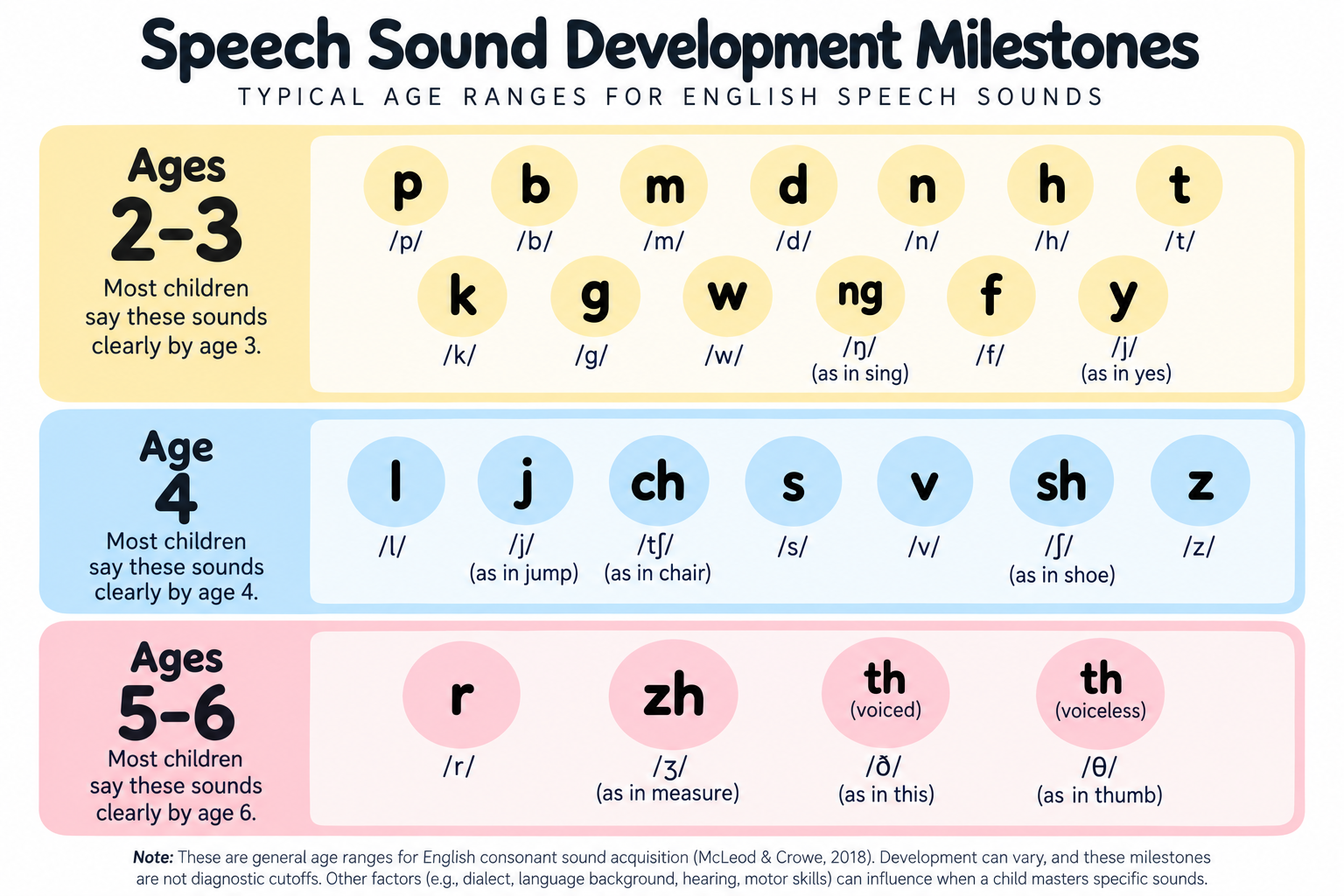
View ASHA’s Consonant Age of Acquisition chart (PDF)
Articulation vs. Phonological Patterns: What’s the Difference?
You may hear an SLP use terms like articulation and phonology.
While these terms are related, they describe different aspects of speech sound development.
Articulation
Articulation refers to how we physically produce individual speech sounds using the lips, tongue, jaw, and other parts of the speech system.
For example, a child may have difficulty producing /k/ and consistently say /t/ instead.
Phonology
Phonology involves how sounds are organized and used within words.
Some children use patterns when simplifying words. For example:
- poon for spoon
- tar for star
- ca for cat
An SLP looks at these patterns to determine whether they are expected for the child's age and whether they are affecting how easily the child can communicate.
It is also possible for a child to demonstrate both articulation and phonological difficulties.
How Understandable Should My Child Be?
One important part of speech development is intelligibility, or how easily other people can understand your child's speech.
You may notice that family members understand your child more easily than teachers, grandparents, or unfamiliar listeners. This is important information for an SLP because familiar listeners often become accustomed to a child's speech patterns.
ASHA notes that by around 4 years of age, children should generally be understood by most people, although they may still make errors on later-developing sounds such as /l/, /r/, /ʃ/ (sh), /tʃ/ (ch), /s/, /v/, /z/, and th.
Remember that speech development is not all-or-nothing. Children develop at different rates, and a child may still be working on certain sounds while being highly understandable overall.
When Should I Be Concerned?
There is no single age when every child should produce every sound perfectly.
Instead, an SLP considers the whole picture, including:
- Your child's age
- Which sounds are difficult
- Whether the errors are consistent
- Whether there are patterns in the errors
- How understandable your child is
- Whether your child becomes frustrated when communicating
- Whether speech differences are affecting participation at home, school, or in the community
- Your child's hearing history
- Development across other areas of communication
ASHA's developmental milestones can be a helpful starting point for understanding what children typically develop at different ages. However, developmental milestones are not a screening or diagnostic tool.
If you have concerns about your child's speech, you do not have to wait until they are old enough to ask questions.
When Should You Reach Out to an SLP?
If you're wondering whether your child's speech is developing as expected, you do not have to figure it out on your own.
An SLP can look at your child's speech as a whole and help you understand:
- What is expected for their age?
- What sounds or patterns are still developing?
- Is their speech affecting how easily others understand them?
- Would monitoring, an evaluation, or therapy be appropriate?
Early support can help families better understand their child's communication needs and determine what support, if any, may be helpful.
At Busy Bee SLP, speech sound therapy is individualized to each child's communication needs and strengths. Sessions are play-based, functional, and designed to help children use their communication skills in meaningful everyday interactions.
If you're concerned about your child's speech, or simply want to learn more, trust your instincts and reach out. A conversation with an SLP can be a helpful first step.
Ready to Talk About Your Child's Speech?
If you're wondering whether your child's speech sounds are developing as expected, Busy Bee SLP offers free consultations and screenings to help families better understand their child's communication.
You do not have to wait until you're certain there is a problem to ask a question.
Sources & Further Reading
- American Speech-Language-Hearing Association (ASHA). Early Identification of Speech, Language, Swallowing, and Hearing Disorders.
- American Speech-Language-Hearing Association (ASHA). Speech Sound Disorders: Articulation and Phonology.
- American Speech-Language-Hearing Association (ASHA). Communication Milestones.
- American Speech-Language-Hearing Association (ASHA). Communication Milestones: 3 to 4 Years.
Coming soon
New resources for all topics are on the way.
Contact your Busy Bee SLP
Phone
330-280-3742
Email
mariah@thebusybeeslp.com
Instagram
@busybee_slp
Location
Saint Petersburg, FL